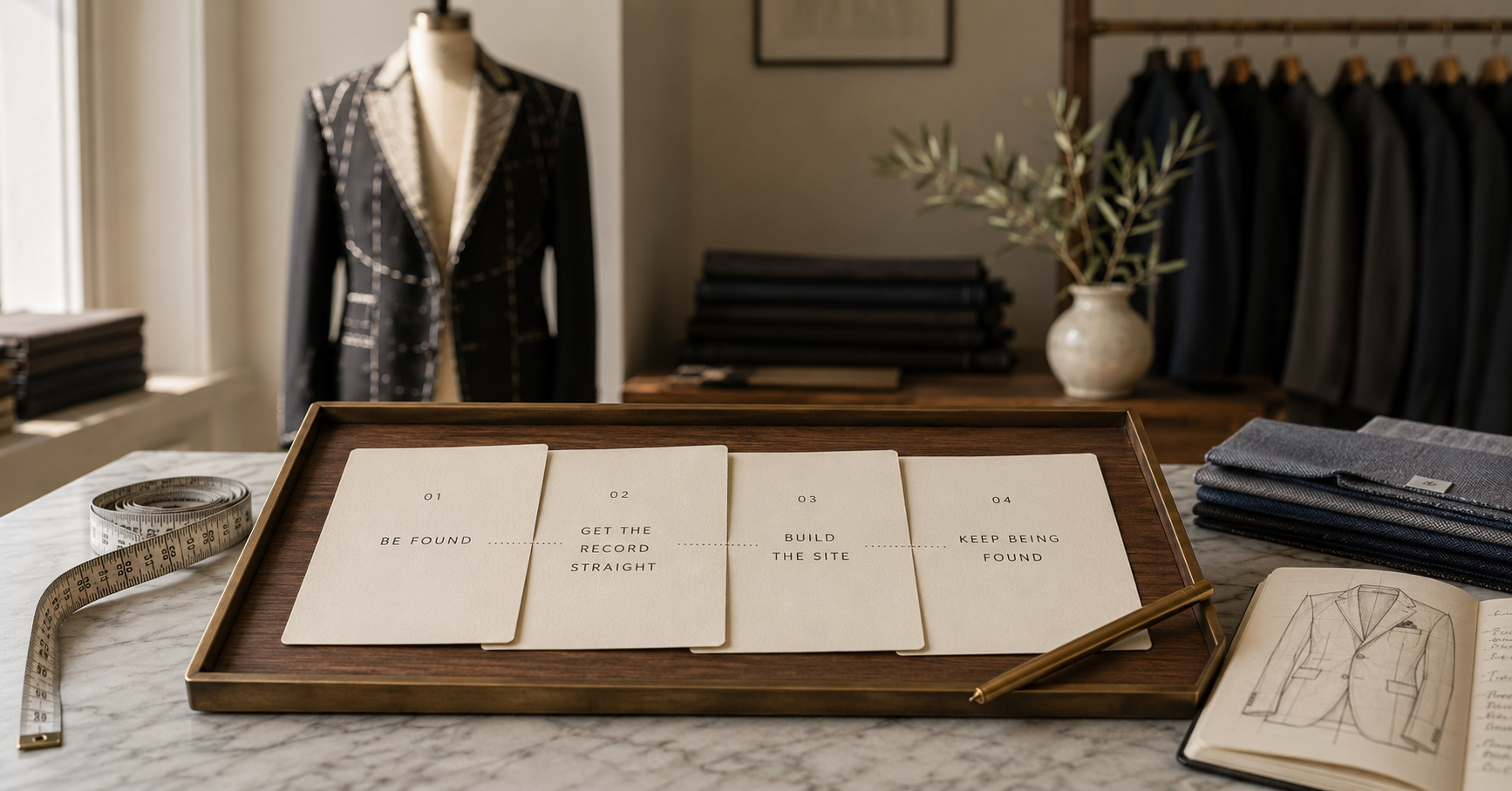
Going online is four separate jobs, not one website project. Being findable where your clients actually look, a site that turns interest into a booked appointment, one place every enquiry lands, and one record holding clients, measurements and orders. Most businesses do the third one, call it done, and wonder why nothing changed.
What does going online actually mean for a tailoring business?
It means moving the finding, the booking and the record online. It does not mean moving the work online.
This is the part that trips people up. “Go online” in most trades means “sell online”, so a tailor hears it and pictures a shop page with garments in it. For a business built on measurements and fittings, that is usually the wrong goal and an expensive one. Nobody orders a commissioned jacket from a product page.
What can move online is everything around the making. How a stranger finds you. How they understand what you do and what it costs. How they book the first appointment without three days of messages. Where their measurements live afterwards, and how they check whether their order is ready.
The cutting, the fitting and the finishing stay exactly where they are. That is the point. Going online should give you more of the work you already do well, not turn you into a different kind of business.
Do you need a website, or is Instagram enough?
Instagram is enough to be seen. It is not enough to be found, and it is not enough to be booked.
Those are different problems. Instagram shows your work to people who already follow you, or who the algorithm decides to show you to. It does almost nothing for the person who opens Google and types “bespoke tailor” and their city, or who asks ChatGPT where to get a suit made before they have heard of anyone. That person is further along and closer to buying, and right now they are not seeing you at all.
The second gap is the booking. A DM thread is not a booking system. It works fine at five enquiries a month and falls apart at thirty, because every one of them needs a person to remember to reply.
Instagram is also not yours. The account can go tomorrow and take the audience with it.
What does the website have to do?
One thing. Get a stranger to book an appointment.
Everything else on the site serves that. The photographs, the fabric range, the story of the workshop, the prices. If a page does not move someone closer to sitting down with you, it is decoration. We wrote about this at length in what kind of website a bespoke brand actually needs, and the short version is that the patterns borrowed from online retail work against you here.
Four things do most of the work:
- Show the garments large and honestly, at a size where the construction reads
- Say who you make for and roughly what it costs, so the wrong enquiries filter themselves out
- Put the same clear next step on every screen, not just the contact page
- Make it fast on a phone, because that is where it will be read
The people who commission this kind of work are not impulse buyers. They visit, leave, think, and come back. The site has to survive that, which is what the Convert side of our work is for.
Where should enquiries and bookings land?
In one place that is not somebody’s personal phone.
Enquiries arrive from four or five directions at once. The website form, Instagram DMs, WhatsApp, email, and people who walk in. That is normal and it is fine. The failure is when each one lives in a different inbox owned by a different person, because then nobody can answer the only question that matters, which is how many people asked us for something this month and how many did we actually get back to.
Pick one place everything gets written down, on the day it arrives. It does not have to be sophisticated at the start. It has to be one place, and it has to be somewhere that survives a staff member leaving or a phone being replaced.
This is also the first point where going online stops being a marketing exercise and starts being an operations one. More enquiries only helps if the enquiries get answered.
What happens to measurements and orders once you are online?
They become the bottleneck, usually about three months in.
Paper and WhatsApp hold up well at ten orders a month. They do not hold at forty. The measurements are in a book, the fabric is on a slip pinned to the roll, the style detail is in the head of whoever took the order, and the reference photos are in someone’s personal chat. Nothing is wrong with any of that until the person holding one of those pieces is off for a week.
There is a second thing that changes. A client who found you online expects to be able to check on their order without calling to ask. If they cannot, they call, and someone spends their evening answering. That is not a small tax once volume arrives.
None of this needs solving on day one. It needs deciding on day one, which is a different thing, and it is why Operations sits alongside the visibility work rather than after it.
What order should you do this in?
Decide the action first, get the record straight second, build the site third, and work on being found last. That is close to the reverse of how it usually happens.
| # | Step | What it fixes | What it costs you to leave until later |
|---|---|---|---|
| 1 | Decide the one action you want a visitor to take | Gives every later decision something to be judged against | You get a site that describes you beautifully and asks for nothing, so traffic arrives and leaves |
| 2 | Get clients, measurements and orders into one record | Makes the business able to absorb more work | You migrate live orders under pressure instead of starting clean, at exactly the moment you are busiest |
| 3 | Build the site around that one action | Turns the people who find you into appointments | You stay dependent on a platform you don’t own, and invisible to anyone searching rather than scrolling |
| 4 | Work on being found: search, maps, AI assistants, social | Brings strangers in at the top | You have a good site nobody arrives at |
Step two is the one people argue with, so here is the reasoning. It is the cheapest of the four and the only one that gets harder the longer you wait, because you are eventually moving orders that are already in progress rather than starting with a clean book. Getting found is the opposite. It compounds, so it should be the thing still running long after the rest is finished. That is the logic behind how we sequence the Be Found work.
One honest exception. If you are getting a handful of enquiries a month and you know every client by name, leave step two on paper and do one, three and four. Fix the record when the volume is real. Buying software for a problem you do not have yet is its own kind of waste.
Common questions
Does a tailoring business actually need a website in 2026?
Yes, if you take appointments from people who don’t already know you. Instagram reaches people who follow you. A website is what search engines and AI assistants read when someone asks where to get something made in your city, and it is the only place you control the booking step.
Can I skip the website and just use Instagram and WhatsApp?
You can, and plenty of good shops do. The limit is that you stay invisible to anyone searching rather than scrolling, and every enquiry arrives as a conversation someone has to personally remember to finish.
Should a tailoring business sell online?
Usually not. Selling finished garments online is a different business from making them to measure. For most tailoring businesses the thing worth moving online is the finding, the booking and the record, not the sale.
How long does it take to get a tailoring business online?
The website is the slowest part and the least urgent. Deciding what you want a visitor to do takes an afternoon, and getting your client and order records into one place can be done in a week. Both of those are worth doing before anyone builds you a site.
What does it cost to take a tailoring business online?
It depends on which of the four jobs you already have covered, which is why we start with an audit rather than a quote. A shop with a good Instagram and a paper order book needs something very different from one with a site nobody visits.