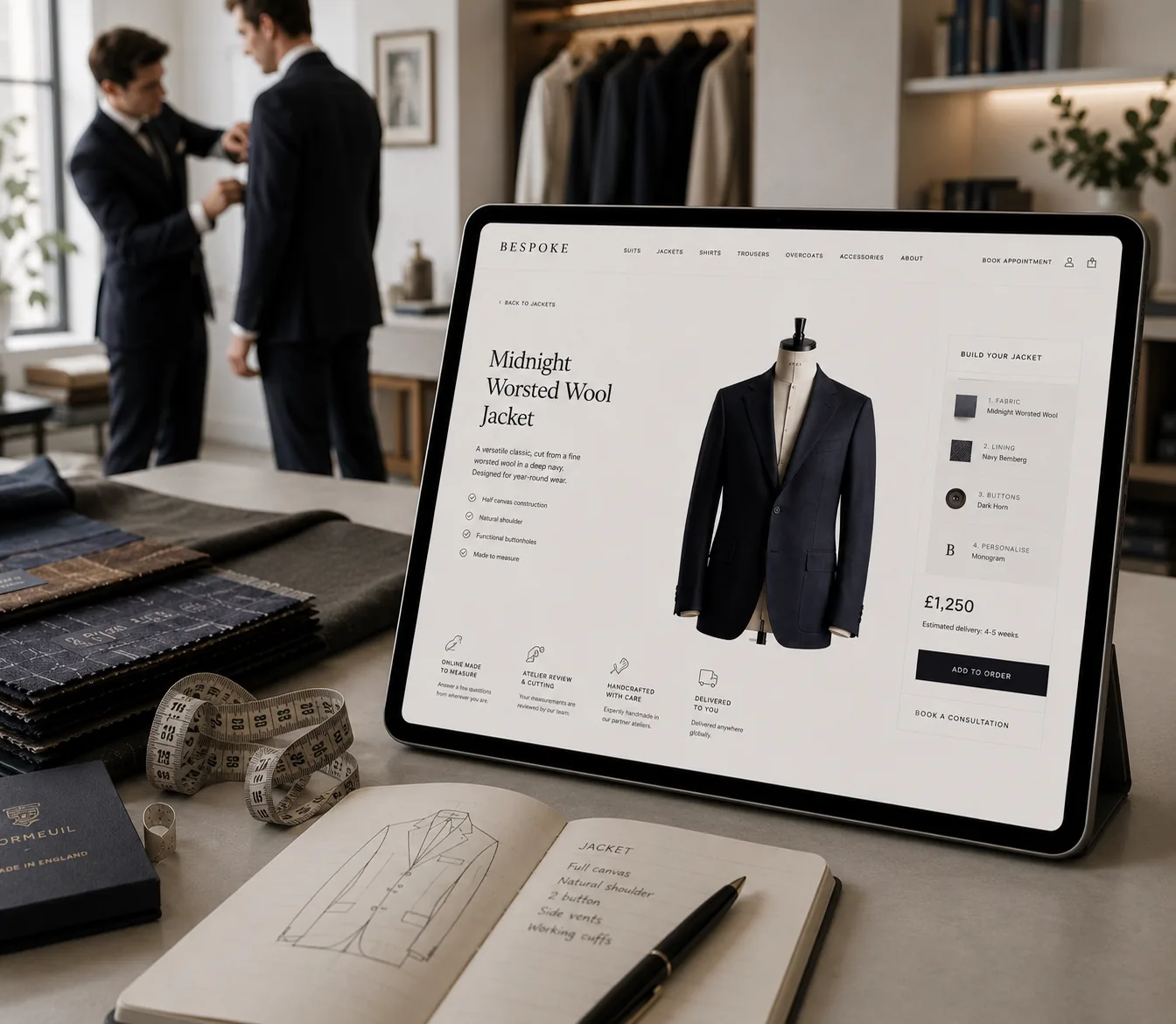
Walk into any conversation about a new bespoke tailor’s website and someone will mention Shopify within five minutes. It’s a reasonable instinct — Shopify built the modern playbook for selling things online. The problem is that bespoke isn’t selling a thing. It’s selling a process, a relationship, and an outcome the client can’t fully visualise until weeks after the first conversation. The patterns that move products through carts are wrong for the way bespoke clients actually decide. Most agencies don’t understand the difference. The brands paying for the work usually find out the hard way.
Bespoke is a considered purchase. Most agencies are still selling for impulse.
A considered purchase is the kind of decision a buyer doesn’t make quickly. The financial cost is meaningful. The emotional stakes are real. The product is complex enough that comparison requires research, and the buyer needs to develop confidence in the brand before they commit. The decision cycle is measured in weeks, sometimes months.
Bespoke fits every part of this definition. A bespoke suit costs the equivalent of a small holiday. A wedding sherwani is bought once, worn at the most photographed moment of a lifetime, and lives in a wardrobe afterward as a personal artefact. A made-to-measure programme for a regular client is a relationship that runs for years.
None of this is a checkout decision.
But the dominant frameworks in web design — the ones every generalist agency knows — were built for impulse and habitual purchases. Cart abandonment recovery. Retargeting cascades. Urgency mechanics. AI personalisation engines designed to nudge unsure buyers across the decision line. These tools exist because most e-commerce sells low-consideration items where the buyer’s attention has to be captured and converted in the same session.
A bespoke client returns to a tailor’s website a dozen times before booking the first fitting. Different device, different question each time. The website’s job isn’t to capture them in one visit. It’s to be the credible reference point across all of them.
Where e-commerce patterns fail bespoke brands
Five patterns that work for e-commerce and actively damage bespoke positioning.
Cart abandonment recovery is irrelevant. A bespoke prospect doesn’t abandon a cart — they think for two weeks, ask their tailor’s existing clients, look at the brand’s social posts, then book a consultation. Recovery emails sent because they “left items in their basket” don’t apply. The basket was never the goal.
Urgency mechanics undermine premium positioning. “Only 3 left in stock” doesn’t make sense for a service produced from scratch. Countdown timers and limited-time discounts read as desperation to an audience that’s paying a premium for craft. Premium audiences notice when a brand acts like it’s selling a deal.
AI personalisation fights the brand voice. Dynamic homepage content that adapts to the visitor — “Hi, recommended for you” — works for marketplaces selling commodity products. For a bespoke brand whose entire value proposition is consistency of vision and editorial restraint, algorithmic personalisation flattens the very thing the brand sells.
The product grid commoditises the work. A grid of garments with prices underneath turns bespoke into a catalogue. The most distinctive thing about bespoke — the conversation, the fabric selection, the fitting process — disappears into thumbnails. The viewer reads the brand as a small-batch retailer instead of a studio.
Speed-to-checkout measures the wrong outcome. Conversion-optimisation orthodoxy says reduce the steps between landing and purchase. For bespoke, the considered pace is the point. A buyer who books a fitting after five minutes on the site has skipped the trust-building the brand was supposed to do. The high-quality bookings come from the slow visitors, not the fast ones.
What bespoke websites actually need to do instead
The work shifts from “convert the visitor” to “be worth returning to.” Five things that matter.
Carry the brand’s weight in atelier and craft. The website is the closest most online prospects get to the studio. Photography, voice, fabric presentation, process documentation — the whole site has to feel like the brand. A bespoke prospect can sense agency-template work in three seconds. The site has to be considered enough to match the work.
Support the multi-week research cycle. A returning visitor needs to find new information each time they come back — depth in fabric pages, atelier story, fitting process documentation, real client work. The site should reward return visits, not punish them with cookie banners and pop-ups.
Multiple paths for different operating models. Studio visits, trunk show appointments, virtual consultations, online ordering — bespoke brands run on different combinations of these. The website’s structure follows from how the brand actually sells. A trunk-show-led brand needs city schedules and travel calendars; an online-first MTM brand needs configurators and measurement guides. One template doesn’t cover both.
Returning-client infrastructure. Existing clients need to reorder against saved measurements, browse new fabric collections, book follow-up fittings. This is where bespoke websites become genuinely different from e-commerce — the long-term client relationship lives on the site, not just the first sale.
Conversation, not checkout. The conversion point isn’t an order — it’s a booked consultation or fitting. Booking flows for bespoke are short, considered, and respect the prospect’s pace. No “complete your purchase” pressure. No upsells. Just a clear path to the next conversation.
Why generalist agencies keep getting this wrong
Three reasons the same mistake repeats.
The frameworks they know are e-commerce frameworks. Most digital agencies built their craft on conversion-optimised retail. The principles they apply — CTR, ROAS, time-to-conversion, average order value — come from selling shoes, gadgets, and subscriptions. The toolkit is real and well-developed. It just doesn’t fit bespoke.
Templates have gravity. A Shopify build with a fabric plugin is faster, cheaper, and easier to scope than a custom site shaped around a specific bespoke brand’s operating model. Most agencies default to the easier path. The brand pays for it later in lost conversions and a site that doesn’t reflect its work.
Bespoke-specific systems require trade fluency generalists don’t have. A measurement system that handles bespoke fitting points and tracks fitting history across years. A fabric library that records provenance, mill information, and seasonal availability. A booking flow that knows the difference between a studio visit and a virtual consultation. These aren’t features that get assembled from existing plugins. They’re built — and building them requires understanding what they need to do.
What bespoke brand owners should ask before commissioning a website
Five questions that surface whether an agency understands the difference.
What’s your conversion model for appointment-based businesses?
If the answer involves cart abandonment, retargeting funnels, or “we’ll A/B test the checkout flow,” the agency is applying e-commerce thinking.
How will the site work for clients who visit eight times before booking?
The answer should describe content depth, return-visit value, and progressive trust-building — not “we’ll capture them with a popup on visit one.”
What does the booking flow look like, and what’s the conversion goal?
A good answer names appointments, consultations, or qualified enquiries — not purchases, orders, or transactions.
How does the site handle returning clients differently from new ones?
A bespoke brand’s repeat clients are its most valuable asset. The site needs infrastructure for them. If the agency hasn’t thought about this, it’s e-commerce thinking with bespoke surface decoration.
What’s your approach to fabric, measurement, and fitting infrastructure?
The answer should reveal whether the agency has built these systems before or whether they’ll be retrofitted from generic e-commerce plugins.
Closing
The mistake most generic agencies make isn’t laziness. It’s applying tools designed for one kind of business to another. Bespoke is a considered, relationship-driven, slow-decision purchase. The website has to support that reality — atelier weight, content depth, considered conversion flows, infrastructure for returning clients. Generic templates can’t do this work, and most agencies haven’t built the tools required. Brands paying premium fees for digital work deserve better than retrofitted Shopify stores. The frameworks exist. The trade fluency is the missing part.
Wondering how your current website performs against the way your clients actually decide? Request a Visibility Audit — we map where the site converts, where it leaks, and what’s missing for the bespoke buying cycle specifically.